Brise soleil, sometimes brise-soleil (French: [bʁiz sɔlɛj]; lit. '"sun breaker"'), is an architectural feature of a building that reduces heat gain within that building by deflecting sunlight.[1] More recently, vertical Brise soleil have become popular. Both systems allow low-level sun to enter a building in the mornings, evenings and during winter but cut out direct light during summer.[2]

Architecture
Brise-soleil can comprise a variety of permanent sun-shading structures, ranging from the simple patterned concrete walls popularized by Le Corbusier in the Palace of Assembly to the elaborate wing-like mechanism devised by Santiago Calatrava for the Milwaukee Art Museum or the mechanical, pattern-creating devices of the Institut du Monde Arabe by Jean Nouvel.[citation needed]
In the typical form, a horizontal projection extends from the sunside facade of a building. This is most commonly used to prevent facades with a large amount of glass from overheating during the summer. Often louvers are incorporated into the shade to prevent the high-angle summer sun falling on the facade, but also to allow the low-angle winter sun to provide some passive solar heating.[3]
Gallery
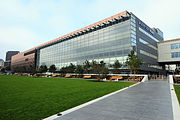


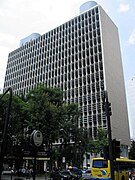

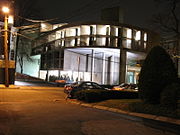


| This article uses material from the Wikipedia article Metasyntactic variable, which is released under the Creative Commons Attribution-ShareAlike 3.0 Unported License. |