Coade stone or Lithodipyra or Lithodipra (Ancient Greek (λίθος/δίς/πυρά), "stone fired twice") was stoneware that was often described as an artificial stone in the late 18th and early 19th centuries. It was used for moulding neoclassical statues, architectural decorations and garden ornaments of the highest quality that remain virtually weatherproof today.


Coade stone features were produced by appointment to George III and the Prince Regent for St George's Chapel, Windsor; The Royal Pavilion, Brighton; Carlton House, London; the Royal Naval College, Greenwich; and refurbishment of Buckingham Palace in the 1820s.[1][2]
The product (originally known as Lithodipyra) was created around 1770 by Eleanor Coade, who ran Coade's Artificial Stone Manufactory, Coade and Sealy, and Coade in Lambeth, London, from 1769 until her death in 1821.[1] It continued to be manufactured by her last business partner, William Croggon, until 1833.[1][3]
The recipe and techniques for producing Coade stone have been rediscovered by Coade Ltd., which produces sculpture at its workshops in Wilton, Wiltshire.[citation needed]
History

In 1769 Mrs Coade[a][b][c] bought Daniel Pincot’s struggling artificial stone business at Kings Arms Stairs, Narrow Wall, Lambeth, a site now under the Royal Festival Hall.[2][5] This business developed into Coade's Artificial Stone Manufactory with Eleanor in charge, such that within two years (1771) she fired Pincot for 'representing himself as the chief proprietor'.[1][2][6]
Coade did not invent 'artificial stone'. Various lesser quality ceramic precursors to Lithodipyra had been both patented and manufactured over the previous forty (or sixty[3]) years prior to its appearance. She was, however, probably responsible for perfecting both the clay recipe and the firing process. It is possible that Pincot's business was a continuation of that run nearby by Richard Holt, who had taken out two patents in 1722 for a kind of liquid metal or stone and another for making china without the use of clay, but there were many start-up 'artificial stone' businesses in the early 18th century of which only Mrs Coade's succeeded.[5][7][8]
The company did well, and boasted an illustrious list of customers such as George III and members of the English nobility.[d] In 1799 Mrs Coade appointed her cousin John Sealy (her mother’s sister Mary’s son), already working as a modeller, as a partner in her business,[8] which then traded as 'Coade and Sealy' until his death in 1813 when it reverted to just 'Coade'.
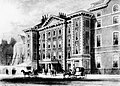
In 1799 she opened a show room Coade's Gallery on Pedlar's Acre at the Surrey end of Westminster Bridge Road to display her products.[1][2][10][11]
In 1813 Mrs Coade took on William Croggan from Grampound in Cornwall, a sculptor and distant relative by marriage (second cousin once removed). He managed the factory until her death eight years later in 1821[11] whereupon he bought the factory from the executors for c. £4000. Croggan supplied a lot of Coade stone for Buckingham Palace; however, he went bankrupt in 1833 and died two years later. Trade declined, and production came to an end in the early 1840s.
Current production
In 2000 Coade ltd started producing statues, sculptures and architectural ornament, using the original eighteenth century recipes and methods.[citation needed]
Material


Description
Coade stone is a type of stoneware. Mrs Coade's own name for her products was Lithodipyra, a name constructed from ancient Greek words meaning "stone-twice-fire" (λίθος/δίς/πυρά), or "twice fired stone". Its colours varied from light grey to light yellow (or even beige) and its surface is best described as having a matte finish.
The ease with which the product could be moulded into complex shapes made it ideal for large statues, sculptures and sculptural façades. One-off commissions were expensive to produce, as they had to carry the entire cost of creating a mould. Whenever possible moulds were kept for many years of repeated use.
Formula
The recipe for Coade stone is still used by Coade Ltd. It is a ceramic, rather than a cementatious material (such as concrete).[citation needed]
Its manufacture required extremely careful control and skill in kiln firing over a period of days, difficult to achieve with its era's fuels and technology. Coade's factory was the only really successful manufacturer.
The formula used was:
- 10% grog
- 5–10% crushed flint
- 5–10% fine quartz
- 10% crushed soda lime glass
- 60–70% ball clay from Dorset and Devon
This mixture was also referred to as "fortified clay", which was kneaded before insertion into a 1,100 °C kiln for firing over four days[9] – a production technique very similar to brick manufacture.
Depending on the size and fineness of detail in the work, a different size and proportion of Coade grog was used. In many pieces a combination of grogs was used, with fine grogged clay applied to the surface for detail, backed up by a more heavily grogged mixture for strength.
Durability
One of the more striking features of Coade stone is its high resistance to weathering, with the material often faring better than most types of natural stone in London's harsh environment.[citation needed] Prominent examples listed below have survived without apparent wear and tear for 150 years. There were, however, notable exceptions.[e] A few works produced by Coade, mainly dating from the later period, have shown poor resistance to weathering due to a bad firing in the kiln where the material was not brought up to a sufficient temperature.[citation needed]
Demise
Coade stone was superseded by products using naturally exothermic Portland cement as a binder, and appears to have been largely phased out by the 1840s.
Examples
Over 650 pieces are still in existence worldwide.[16][17]
- Banff, Aberdeenshire, Scotland. Duff House Mausoleum, Wrack Woods. James Duff, 2nd Earl Fife built the mausoleum for his family in 1791, possibly on the site of a Carmelite friary. Built before the Gothic Revival, this is an example of "Gothick" architecture. Typically Georgian – the carvings, including the monument to the first Earl, are in Coade stone.(57.654185°N 2.537119°W)
- Bath, 8 Argyll Street – The Royal Arms of Queen Charlotte are above the entrance to A.H.Hale, (Pharmacy) established 1826.(51.383375°N 2.356795°W)
- Brighton – Royal Pavilion of King George IV.(50.822397°N 0.137835°W)
- Buckingham Palace (in a section not open to the public)(51°30′3″N 0°8′31″W)
- Burnham Thorpe – Nelson's Memorial.(52.936°N 0.760°E)
- Burton Constable Hall in the East Riding of Yorkshire, displays 3 figures and a number of 'medallions' above the doors and windows of the Orangerie. In 1966 this was designated as Grade II*.[18] (53.813740°N 0.196000°W)
- Carlton House, London.(51.506138°N 0.131672°W)
- Castle Howard.(54.121464°N 0.905812°W)
- Chichester – The Buttermarket, which was designed by John Nash (coat of arms engraved with "Coade & Sealey 1808")(50.837477°N 0.778947°W)
- Chiswick House, London. A couple of large ornate urns in the Italian Garden.(51.483611°N 0.258611°W)
- Culzean Castle, overlooking the Firth of Clyde, near Maybole, Scotland. Cat Gates – The original inner entrance with Coade stone cats (restored in 1995) surmounting the pillars. The lodge cottages were demolished in the 1950s.(55.354400°N 4.789500°W)
- East Grinstead, Hammerwood Park. The plaques at Hammerwood Park are made of Coade stone.(51.1312°N 0.0595°E)
- Edinburgh, "The statue of Hygieia" in the St Bernard's Well building by the Water of Leith "is made of coade stone".[19]
- Exeter – Coade stone doorways on the terrace in 'Palace Gate' between the cathedral and South Street. Several late 18th century houses near Exeter Cathedral have doorway surrounds decorated with a keystone face (chosen from a small range of moulds), and decorative blocks.(50.721310°N 3.530000°W)
- Great Yarmouth – Britannia Monument (52.5884°N 1.7336°E)
- Highclere Castle, Hampshire. 'London Lodge' (1793), Brick but Coade stone dressed, and wings (1840).(51.340650°N 1.342786°W)
- Imperial War Museum, London. Sculptural reliefs above the entrance.(51.495994°N 0.108606°W)
- Kensington High Street, London. The lion and unicorn statues on pillars at the entrance to Kensington Palace.[20](51.502436°N 0.187594°W)
- Kew Gardens – The lion and unicorn statues over their respective gates into The Royal Botanical Gardens.(Lion Gate-51.470595°N 0.293594°W)(Unicorn Gate-51.477088°N 0.290914°W)
- Lyme Regis, Dorset – Eleanor Coade's country home at Belmont House decorated with Coade stone on its façade.(50.72434°N 2.94006°W)
- The Octagon House or the John Tayloe III House in Washington, DC, built 1800 by William Thornton.
- Montreal – Nelson's Column, built 1809. The statue and ornaments.(45°30′30″N 73°33′14″W)
- Pitzhanger Manor House, Ealing, was owned from 1800 to 1810 by the architect Sir John Soane, who radically rebuilt it. It features four Coade stone caryatids atop the columns of the east front, modelled after those that enclose the sanctuary of Pandrosus in Athens.(51.511091°N 0.307210°W)
- Portobello, Edinburgh, Portobello Beach, three Coade Stone columns in the community garden at 70 Promenade (John Street), Portobello Beach, rescued from the garden of Argyle House, Hope Lane, off Portobello High Street until they were taken into Council storage in 1989 when a new extension was built onto the house.[21] (55.952090°N 3.104139°W)
- Richmond upon Thames. Two examples of the River God, one outside Ham House, the other in Terrace Gardens.(Ham House-51.444650°N 0.314296°W) (Terrace Gardens-51.453988°N 0.300406°W)
- Rio de Janeiro zoo entrance.(22.904400°S 43.228843°W)
- Roscommon, Ireland, Entrance gate to former Mote Park demesne, The Lion Gate, built 1787, consisting of a Doric triumphal arch surmounted by a lion with screen walls linking it to a pair of identical lodges.[22] (53.590311°N 8.143123°W)
- Royal Naval College, Greenwich – Admiral Lord Nelson's Pediment in the King William Courtyard of the Old Royal Naval College was regarded by the Coade workers as the finest of all their work. It was sculpted by Joseph Panzetta in 1813, as a public memorial after his death at the Battle of Trafalgar in 1805. It was based on a painting by Benjamin West depicting Nelson's body being offered to Britannia by a Winged Victory. It was cleaned in 2016.[23] (51.483278°N 0.005564°W)
- Saxham Hall, Suffolk has an Umbrello (shelter) constructed of Coade stone in the grounds[24] (52.234094°N 0.630431°E)
- Schomberg House at 81–83 Pall Mall, London was built for Meinhardt Schomberg, 3rd Duke of Schomberg in the late 17th-century. The porch, framed by two Coade stone figures, was added in the late 18th century. Note – The figures that framed the doorway of the original Coade's Gallery, on Pedlar's Acre at the Surrey end of Westminster Bridge Road were made from the same moulds.[23] (51.505833°N 0.135833°W)
- Shrewsbury, Shropshire. Lord Hill's Column. (52.7041°N 2.7318°W)
- South Bank Lion at the south end of Westminster Bridge in central London originally stood atop the old Lion Brewery, on the Lambeth bank of the River Thames. When the brewery was demolished in 1950, to make way for the South Bank Site of the 1951 Festival of Britain, the Lion was taken down and moved to Station Approach Waterloo, painted red as the symbol of British Rail on high plinth. When removed, the initials of the sculptor William F. Woodington and the date, 24 May 1837, were discovered under one of its paws.[3] The fine details still remain clear after 170 years of London's corrosive atmosphere, caused by heavy use of coal throughout the 19th and first half of the 20th centuries. The red paint was removed to reveal the fine Coade stone surface to view. In 1966,[25] the statue was moved from outside Waterloo station[26] to its current location.(51.500836°N 0.119581°W)
- Southwark – Statue of King Alfred the Great, Trinity Church Square. The statue of a king on the stone plinth in the square is Grade II listed. The provenance is unknown, but it may be either one of eight medieval statues from the north end towers of Westminster Hall (c. late 14th century) or, alternatively, one of a pair representing Alfred the Great and Edward, the Black Prince made for the garden of Carlton House in the 18th century.[27](51.498815°N 0.093713°W)
- St Botolph-without-Bishopsgate Church Hall, London, pair of statues of schoolchildren on the front of this former School House, replicas outside, listed originals now inside the Hall.(51.516708°N 0.081656°W)
- St Mary-at-Lambeth, Garden Museum, London – Captain Bligh's tomb in the churchyard of St Mary's Lambeth.(51.4950°N 0.1202°W)
- Towcester Racecourse on the Easton Neston estate – Main Entrance Gate decorated with an array of dogs, urns and vases surmounted by the Fermor arms, signed by William Croggon.(52.122437°N 0.973085°W)
- Tremadog, Gwynedd, Wales. St Mary's Church Lychgate. Tremadog was founded, planned, named for and built by William Madocks between 1798 and 1811. The Lychgate to the churchyard is spanned by a decorative arch of Coade stone, containing boars, dragons, frogs, grimacing cherubs, owls, shrouded figures and squirrels, while the tops of the towers are surrounded by elephant heads.[28](52.938678°N 4.140833°W)
- Twinings' first ever (and still operating) shop's frontispiece, in the Strand, London opposite the Royal Courts of Justice, rediscovered under soot after a century.(51.513347°N 0.112924°W)
- University of Maryland, College Park, United States – The keystone, featuring a carving of the head of Silenus, above the entry to The Rossborough Inn.(38.9853°N 76.9376°W)
- Weymouth, Dorset the statue of George III on the seafront.(50.611973°N 2.453883°W)
- Windsor Castle, St George's Chapel. Mrs Coade was commissioned by King George III to make the Gothic screen (and possibly also replace part of the ceiling) of St George's Chapel. (51.48376°N 0.60678°W)
In 2020, the library of Birkbeck, University of London launched the Coade Stone image collection online, consisting of digitised slides of examples of Coade stone bequeathed by Alison Kelly, whose book Coade Stone was described by Caroline Stanford as "the most authoritative treatment on the subject".
Gallery



| This article uses material from the Wikipedia article Metasyntactic variable, which is released under the Creative Commons Attribution-ShareAlike 3.0 Unported License. |