Jettying (jetty, jutty, getee (obsolete) from Old French getee, jette)[1] is a building technique used in medieval timber-frame buildings in which an upper floor projects beyond the dimensions of the floor below. This has the advantage of increasing the available space in the building without obstructing the street. Jettied floors are also termed jetties.[2][3] In the U.S., the most common surviving colonial version of this is the garrison house.[4] Most jetties are external, but some early medieval houses were built with internal jetties.[5]
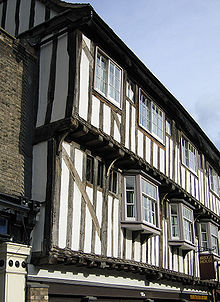
Structure
Vertical elements
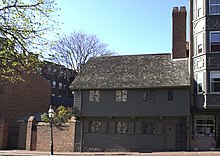

The vertical elements of jetties can be summarized as:
- the more massive corner posts of the timber frame that support the dragon beam from the floor below and are supported in their turn by the dragon beam for the extended floor above.
- the less substantial studs of the close studding along the walls above and below the jetty.
Horizontal elements
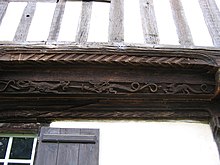
The horizontal elements of jetties are:
- the jetty breastsummer (or bressummer), the sill on which the projecting wall above rests; the bressummer stretches across the whole width of the jetty wall
- the dragon-beam which runs diagonally from one corner to another, and supports the corner posts above and is supported in turn by the corner posts below
- the jetty beams or joists which conform to the greater dimensions of the floor above but rest at right angles on the jetty-plates that conform to the shorter dimensions of the floor below. The jetty beams are morticed at 45° into the sides of the dragon beams. They are the main constituents of the cantilever system and they determine how far the jetty projects
- the jetty-plates, designed to carry the jetty-beams or joints. The jetty-plate itself is supported by the corner posts of the recessed floor below.
Cantilever
Jettying was used for timber-framed buildings, but was succeeded by cantilever which are used for the same reason as jettying, to maximise space in buildings. This is often utilised on buildings which are on a narrow plot and space is at a premium.
Forebay
The Pennsylvania barn in the U.S. has a distinctive cantilever called a forebay, not a jetty.[10]
Mediterranean area
The traditional Turkish house is a half-timbered house with a cantilevered or supported overhang called a cumba.
In the North African Maghreb, houses in medieval city Kasbahs often featured jetties. Contemporary examples still survive in the Casbah of Algiers.
The House of Opus Craticum built before AD 79 in Roman Herculaneum has a supported cantilever.
| This article uses material from the Wikipedia article Metasyntactic variable, which is released under the Creative Commons Attribution-ShareAlike 3.0 Unported License. |