Hindu temples are built in the Panchayatana layout: the main shrine is surrounded by four subsidiary shrines.[1] The origin of the name are the Sanskrit words Pancha (five) et ayatana (containing).
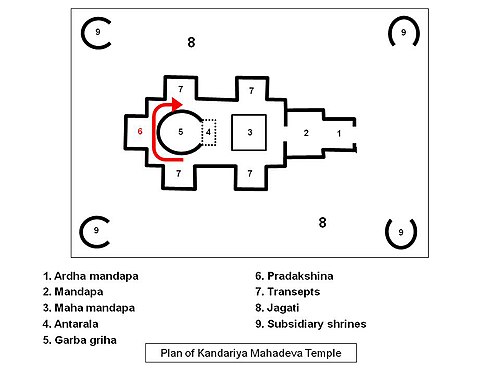
Example with the plan of the Kandariya Mahadeva Temple in Khajuraho with the subsidiary sanctuaries : see numbers 9.
Generally, Hindu temples are built along a west-east axis. So the four subsidiary shrines are at the north-east, south-east, south-west, north-west.
Examples of Panchayatana temples
- Kandariya Mahadeva Temple in Khajuraho
- Brahmeswara Temple in Bhubaneswar
- Jagdish Temple in Udaipur
- Lakshmana Temple in Khajuraho
- Lingaraja Temple in Bhubaneswar
- Arasavalli Temple near Srikakulam District of Andhra Pradesh near Visakhapatnam. Main shrine dedicated to Aditya. Subsidiary shrines dedicated to Ganesh, Shiva, Parvati and Vishnu.[2]
- Dashavatara Temple in Deogarh, Uttar Pradesh. It should be the oldest panchayatana temple in India.
- Nabaratna Temple in Pantchupi
- Shiva Panchayatana Temple in Tumbadi, Tumkur district. Subsidiary shrines dedicated to Lakshmi Narasimha, Vinayaka, Parvati and Surya.
- Gondeshvara temple, in Sinnar, Maharashtra[3]
| This article uses material from the Wikipedia article Metasyntactic variable, which is released under the Creative Commons Attribution-ShareAlike 3.0 Unported License. |